


43L Square Heavy-Duty Tub - Storm (3-Pack Bundle)
Flat $15 shipping anywhere in Australia. Free for orders over $135
150kg static load. 110kg by the handles. Both lab tested.
Made from 100% recycled material

Australian Owned
Limited production run
Description
Three tubs. Flexible when you want, sturdy when you need.
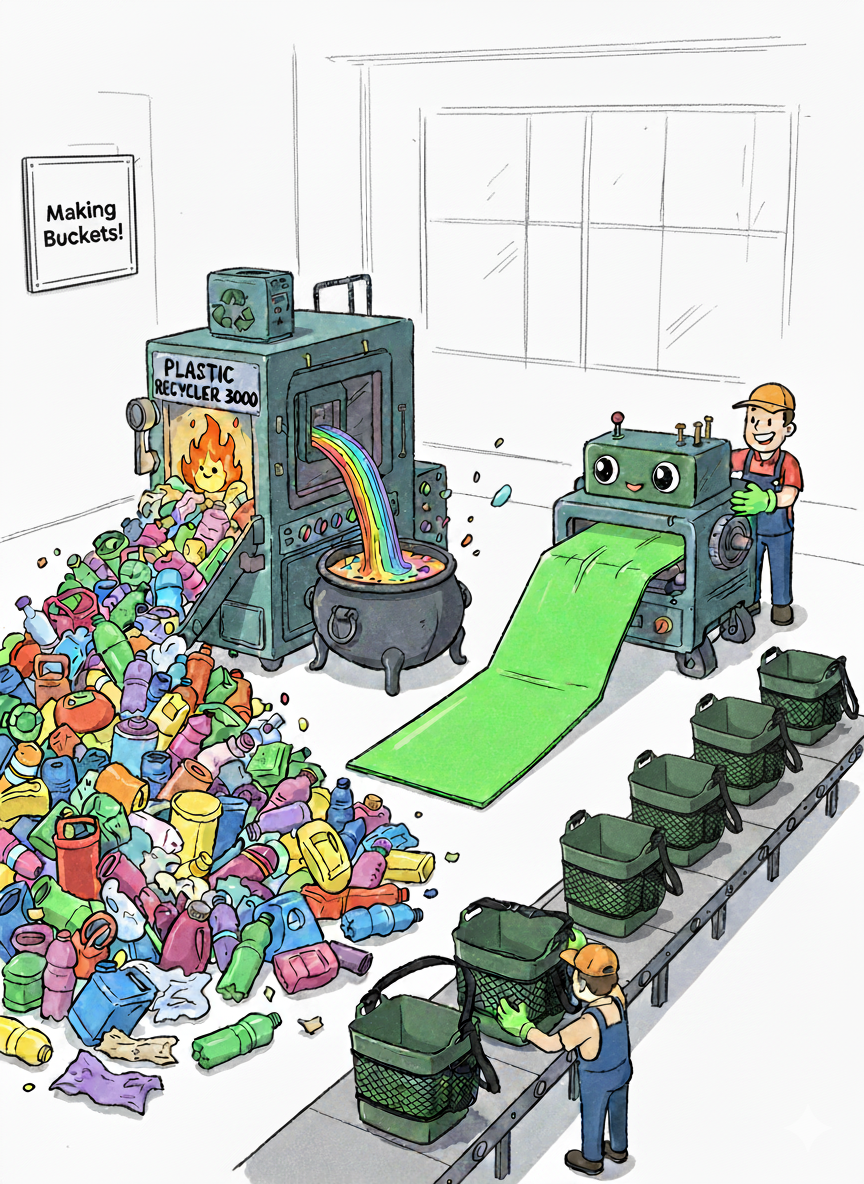
Stop buying cheap plastic buckets that crack after one summer. The BOWWA® 43L Square Heavy-Duty Tub is made in Spain from 100% recycled material, including Tetra Pak cartons. That blend of plastic and aluminium is what makes it UV stabilised and built to take the Australian sun, the salty coast and the heavy haul.
150kg static load. 110kg by the handles. Both lab tested.
- Square, not round. Sits flush against a wall, a ute tray or the back seats, where a round bucket wastes the corners.
- Handles shaped to be held. Reinforced, and wide enough that a full load doesn't bite into your fingers.
- Stands open, folds in. Thick walls hold their shape when you load it, then give enough to squeeze the handles together for a one-handed carry.
- Good enough for the house. A matte, speckled finish in Storm. No two are exactly alike, which is just the recycled material showing itself.
SPECS AND MATERIALS
SHIPPING AND DELIVERY
Flat $15 anywhere in Australia. Free on orders over $135.
Sent with Australia Post, tracked, no signature required. PO boxes are fine.
Most metro orders land in two to four business days. Regional and remote take longer.
Small batch. Chuck one in while we've got them.

Bowwa® Tub 27L (SQUARE)
Deep Granite
$35.00
Out of stock
FAQ's
Can I buy just one?
No, three is the minimum, and the reason is freight.
A bucket is mostly air. Couriers charge on the space something takes up rather than what it weighs, so a single tub costs nearly as much to send as three do. The saving grace is that these nest, so three of them travel in barely more room than one. Selling them one at a time would mean charging you almost the same delivery for a third of the product, and that isn't a good deal for anybody.
Three turns out to be a handy number anyway. One goes dirty, one goes wet, one stays clean, and you stop having to work out which is which.
You can mix colours across your three, and it works out cheaper per tub than a single would have been.
What makes these different from a hardware store bucket?
Four main things, and none of them are marketing.
1. Most buckets are made from a single virgin plastic. These are moulded from 100% recycled PolyAl, which is the polyethylene and aluminium left behind when used Tetra Pak cartons are recycled.
2. It's a harder material to work with than virgin plastic, which is why hardly anyone bothers, and the people who do it best are in Spain, which is where these are made.
3. A standard bucket goes one of two ways: the handle breaks, or it splits down a side or and bottom. The handles on ours are reinforced and moulded in, and the walls flex under load, so there's nowhere for a crack to start. They're UV stabilised too, so the colour doesn't chalk off.
4. Then there's the design. Someone actually thought about the handle shape, the wall thickness and what the thing looks like sitting by a back door. That might sound like it should be normal, but for a bucket, it isn't.
None of that makes them cheap. It makes them the last tubs you'll buy for a long while.
Will they fade or go brittle in the sun?
They're UV stabilised, which is a treatment through the material rather than a coating on it, so it doesn't wear off.
We won't tell you they last forever. The sun gets everything eventually. UV stabilised just buys you a lot more summers than the cheap ones get, and the flex means that when the material does age it doesn't go brittle and crack the way rigid plastic does.
Leaving them in full sun year round will still shorten their life. Under the house or in the shed between jobs is worth doing.
Are they food safe?
Not certified food grade, no. The honest detail is more interesting than a straight no, though.
The material started life as food packaging. These are made from used milk and juice cartons, so the raw input was holding food before it ever became a tub. What it doesn't have is food contact certification for its second life, because recycled material goes through a mixed stream and nobody certifies the output for food. That's a paperwork gap rather than anything alarming, but it's a real one and we're not going to pretend otherwise.
What it does have is worth knowing. There's no BPA in it, confirmed by the people who make it, and BPA isn't used to make any of the plastics in here anyway. It belongs to a different family altogether. The raw material also meets REACH and CLP, the European regulations covering chemical safety and hazard classification, and Europe is about as strict on this as anywhere in the world.
In practice: ice and sealed drinks at a party are completely fine, and plenty of people use them exactly that way. Storing or preparing food directly against the plastic isn't what they're built for.
Can I recycle the tub when it's finished?
Yes, though not in your kerbside bin.
The material is a blend of polyethylene and aluminium, which can be shredded and melted down and made into something else. That's exactly how these got made in the first place, out of used Tetra Pak cartons.
What it can't do is go in the yellow bin. Kerbside sorting is built around single plastics, and this is a mix of four, so it gets picked out and landfilled rather than recycled. Your local transfer station or resource recovery centre is the place to ask, as many of them take hard plastics like buckets, crates and garden furniture. What's accepted varies by council.
The better answer is that we'd rather it lasted long enough that the question doesn't come up for a very long time. That's the whole point of building them out of this stuff instead of the cheap alternative.
Where can I take my Tetra Paks to be recycled?
It depends on where you live, which is an annoying answer but an honest one.
Some councils accept cartons in the kerbside recycling bin and some don't, and it can also come down to the type of carton. The best place to sort it out is Planet Ark's Recycling Near You website. Put your postcode in and it will tell you exactly what your own council takes, and it covers just about everything else in the house while you're there.

Want a mix or need more than 3?
Use our builder
Grab at least three tubs to get started. Mix your colours, shapes and sizes, stack 'em up, and the price drops as you add more.

Not your average floppy bucket
Style meets strength
Flexible where you want it, tough where you need it.
150kg static load. 110kg by the handles. Both lab tested.
Unlike cheap buckets that snap at the handle, ours are reinforced and shaped to be held. Wide enough that a full load doesn't bite into your fingers.
Finished with a unique recycled texture and available in our Elements Palette: Red Earth, Alpine and Storm.
Tough enough for the ute tray, stylish enough for the living room.
Sustainably tough
The recycled story you can see
Our buckets are crafted in Spain from 100% recycled material, including repurposed food and drink cartons (like Tetra Pak). This commitment to sustainability results in a unique, high-performance material. The bucket has a subtle, tactile texture that sets it apart from standard plastic. Look closely and you’ll see tiny authentic flecks of recycled aluminium giving each beautifully coloured bucket a unique finish and telling the genuine story of its origin.